Before You Place That Order
Guest blog contributed by Whitney Scott.
Whitney Scott is one of the outdoor hospitality industry's leading voices in brand strategy, market intelligence, and business growth. Also an American Glamping Association Advisor, AGA Glamping Awards Winner, and AGA Expert, Whitney has helped shape some of the most recognized brands in outdoor lodging by driving growth, innovation, and strategic positioning across the sector. As Co-Founder of Walden, she works with glamping operators, outdoor resorts, destinations, and tourism organizations to turn data into actionable business decisions. Combining deep industry knowledge with a passion for helping businesses succeed, Whitney brings a unique perspective on where the outdoor hospitality market is headed and how operators can position themselves for long-term success.
Part I: Understanding Unique Accommodations
For many operators, vacation rental enthusiasts and hospitality visionaries, this is the season when ideas start becoming commitments.
A piece of unused land suddenly becomes a development opportunity. An underperforming area of a campground starts looking like a place for expansion. A long-discussed master plan begins moving toward budgeting conversations. Manufacturers are being evaluated, financing is being explored, and operators are starting to think about what they want ready for next season.
The reality is that accommodation decisions rarely happen when construction begins. They happen months earlier.
Long before permits are submitted, foundations are poured, or units arrive on site, operators are making decisions that will influence occupancy, guest experience, operational complexity, and return on investment for years to come. That's what makes this point in the year so important. As we head into another planning and purchasing cycle, I've been thinking a lot about a question that surfaces repeatedly across the industry:
What should I build?
It's a deceptively simple question.
And increasingly, it's becoming a difficult one to answer.
Over the next three articles, I'll explore the three major accommodation categories shaping hospitality today: Unique Accommodations, Cabins, and Tents. Each category brings its own opportunities, complexities, investment considerations, and guest expectations. Understanding those differences is becoming increasingly important as operators look for ways to differentiate properties, activate land, improve performance, and create experiences guests cannot easily find elsewhere.
We'll begin with perhaps the fastest-evolving category in the market: Unique Accommodations.
The Emergence of a Third Category
Historically, outdoor hospitality operated around two primary accommodation types: tents and cabins.
Today, there's a growing third category sitting between them: Unique accommodations.
While often grouped together, this category encompasses an incredibly diverse collection of products including domes, yurts, pods, wagons, treehouses and elevated structures, converted containers, and converted RVs.
In developing Walden's North American Unique Accommodations Guide, we reviewed more than 750 accommodation products across 137 manufacturers, just on our continent. creating what is likely the most comprehensive benchmark of this category assembled to date.What emerged from that research wasn't simply a collection of interesting structures.It was evidence that unique accommodations have evolved into a legitimate lodging category of their own.
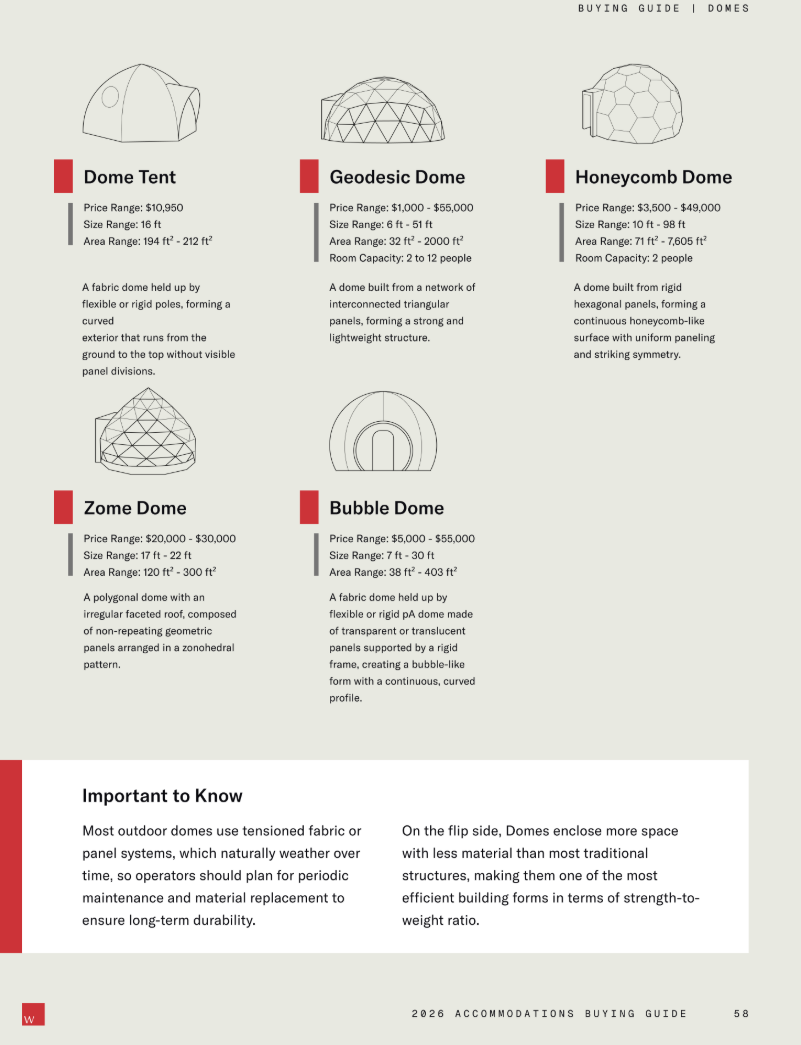
Domes: Selling Unique Emersion At a Glance
Average Footprint: 500 to 700 sq. ft.
Typical Capacity: 2 to 6 guests
Price Range: $1,000 to $55,000+
Common Subcategories: Geodesic Domes, Bubble Domes, Honeycomb Domes, Zomes, Dome Tents
Why Operators Buy Them
Few accommodation types have captured the imagination of outdoor hospitality quite like domes. Their popularity stems from their ability to blur the line between indoor and outdoor living. Large viewing panels, skylights, and open floor plans transform the surrounding landscape into part of the guest experience. Whether positioned beneath dark skies, overlooking mountains, or nestled within forests, domes create a sense of immersion that few other accommodations can match.
They're also remarkably versatile. Within the guide, domes ranged from small glamping units to structures exceeding 2,000 square feet capable of serving as event spaces, wellness facilities, restaurants, or gathering areas. For operators seeking accommodations that generate social sharing and memorable guest experiences, domes often sit near the top of the list.
Pause Before You Buy
Many first-time dome buyers focus on the view and underestimate the environment.
Those beautiful panoramic windows and transparent panels are exactly what guests love, but they can also create significant heat gain. In southern climates or exposed locations, domes can quickly become sweatboxes if the manufacturer hasn't thoughtfully addressed insulation, ventilation, glazing, shading, and HVAC design. Two domes that look nearly identical in a brochure can perform very differently in the field.
Before purchasing, understand how the dome is engineered for your climate. Another common conundrum with domes is matching furniture and flow within a round space. We don’t usually build inside a circle. Try it before you buy it with your own furnishings, it's hard! You can lose a lot of square footage if you haven’t first mapped straightline furnishings and walls with the rounded curves of a dome.
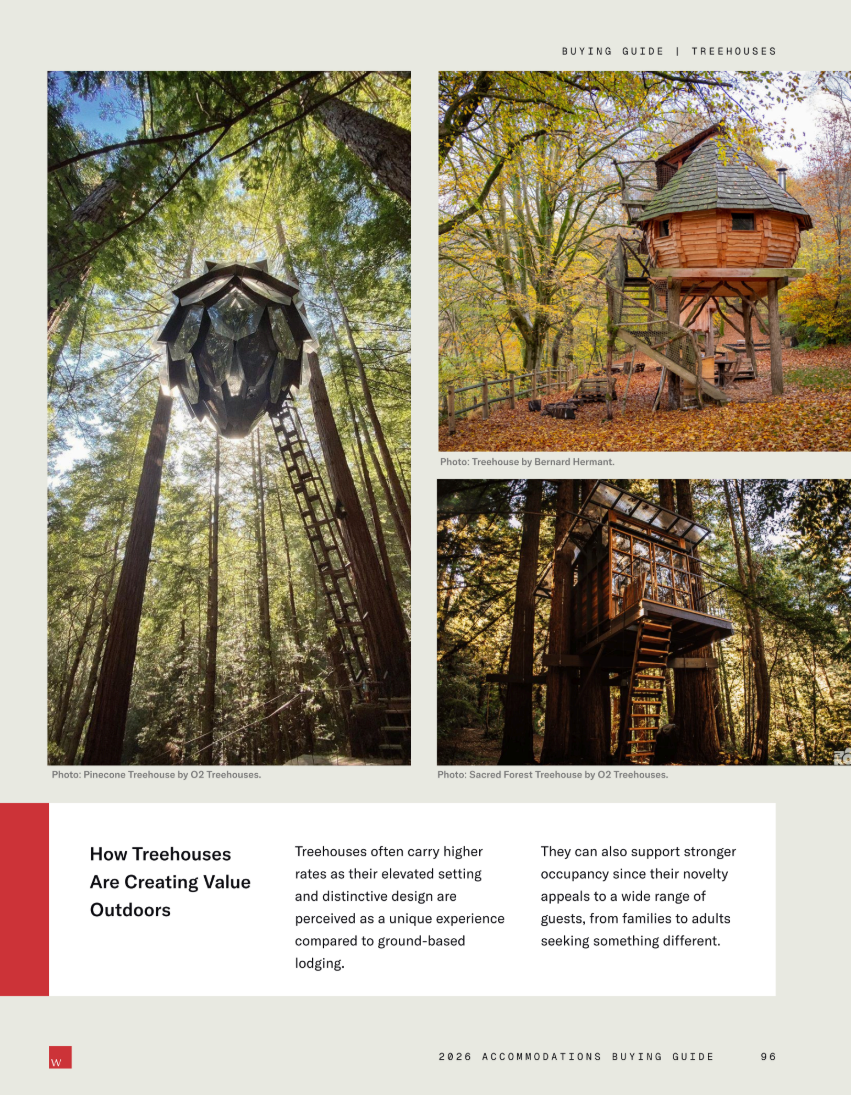
Treehouses & Elevated Structures: Selling Wonder
At a Glance
Average Footprint: 300 to 800 sq. ft.
Typical Capacity: 2 to 8 guests
Price Range: $15,000 to $500,000+
Common Subcategories: Treehouses, Elevated Cabins, Suspended Structures, Lookout Towers
Why Operators Buy Them
If domes immerse guests in the landscape, treehouses and elevated structures change the way guests experience it. Elevation creates views, privacy, exclusivity, and a sense of discovery. These structures often become the signature accommodation on a property and frequently serve as marketing assets that shape a destination's identity.
Many operators are drawn to elevated accommodations because they can activate terrain that might otherwise be difficult to develop while creating experiences that command premium nightly rates.
Pause Before You Buy
Gravity is not your friend.
Every utility serving an elevated structure has to travel uphill. Water lines, sewer systems, electrical infrastructure, internet connections, and HVAC components all become more complex once you leave the ground.
In colder climates, even temperatures hovering around freezing can create problems if plumbing systems are not adequately insulated, heated, or protected. Operators often focus on the structure itself while underestimating the complexity of what happens beneath it.
Liability should also be part of the conversation. Stairs, railings, elevated decks, accessibility, emergency access, and long-term maintenance all become increasingly important as structures leave the ground. The higher the structure, the more critical engineering, inspections, and ongoing upkeep become.
Containers: Selling Modern Design
At a Glance
Average Footprint: 160 to 960 sq. ft.
Typical Capacity: 2 to 6 guests
Price Range: $8,000 to $55,000+
Common Subcategories: Single Container, Multi-Container, Hybrid Modular Designs
Why Operators Buy Them
Containers appeal to operators looking for accommodations that feel modern, durable, and architecturally distinctive. Their modular nature allows for incredible flexibility, from compact studio units to multi-container luxury suites.
For many guests, containers represent contemporary outdoor living. They feel intentional, design-forward, and different from traditional lodging options. Their steel construction and modularity also make them attractive to operators looking for long-term durability.
Pause Before You Buy
At the end of the day, you're still working with a steel box.
Without proper insulation, thermal breaks, ventilation, and climate control systems, containers can become extremely hot in summer and difficult to heat in winter. Moisture management can also become a concern in humid climates.
Many buyers focus on the structure price without fully understanding the costs associated with transportation, crane placement, foundations, insulation packages, utility connections, and site preparation. The true project cost often extends well beyond the container itself.
Converted RVs: Selling Nostalgia
At a Glance
Average Footprint: 150 to 400 sq. ft.
Typical Capacity: 2 to 6 guests
Price Range: $5,000 to $50,000+
Common Subcategories: Vintage Campers, Airstreams, Fifth Wheels, Bus Conversions, Park Models
Why Operators Buy Them
Few accommodation categories tap into emotion as effectively as converted RVs. Long before glamping became a trend, recreational vehicles represented freedom, exploration, and the romance of the open road. Today, restored Airstreams, vintage campers, and thoughtfully converted RVs allow operators to capitalize on that nostalgia while creating accommodations that feel approachable and familiar.
They can also be one of the fastest ways to add inventory. Many arrive with integrated plumbing, electrical systems, kitchens, and bathrooms already in place. For operators looking to activate land quickly or test a concept before investing in permanent structures, converted RVs often provide a lower barrier to entry than other accommodation categories.
The best examples feel less like old RVs and more like boutique hotel rooms with a story to tell.
Pause Before You Buy
Not every old RV deserves a second life.
One of the biggest mistakes operators make is assuming that vintage automatically means charming. Guests can tell the difference between a thoughtfully restored accommodation and a tired RV with fresh paint.
Quality matters. Design matters. Comfort matters.
Permitting can also become surprisingly complicated. Depending on the jurisdiction, an RV, park model, mobile accommodation, or permanent lodging structure may all fall under different regulations. What is allowed in one county may not be allowed in another. Before purchasing a fleet of converted RVs, make sure you understand how local officials classify them.
Pods: Selling Efficiency
At a Glance
Average Footprint: 100 to 500 sq. ft.
Typical Capacity: 2 to 4 guests
Price Range: $10,000 to $80,000+
Common Subcategories: Sleeping Pods, Luxury Pods, Modular Pods, Micro Cabins
Why Operators Buy Them
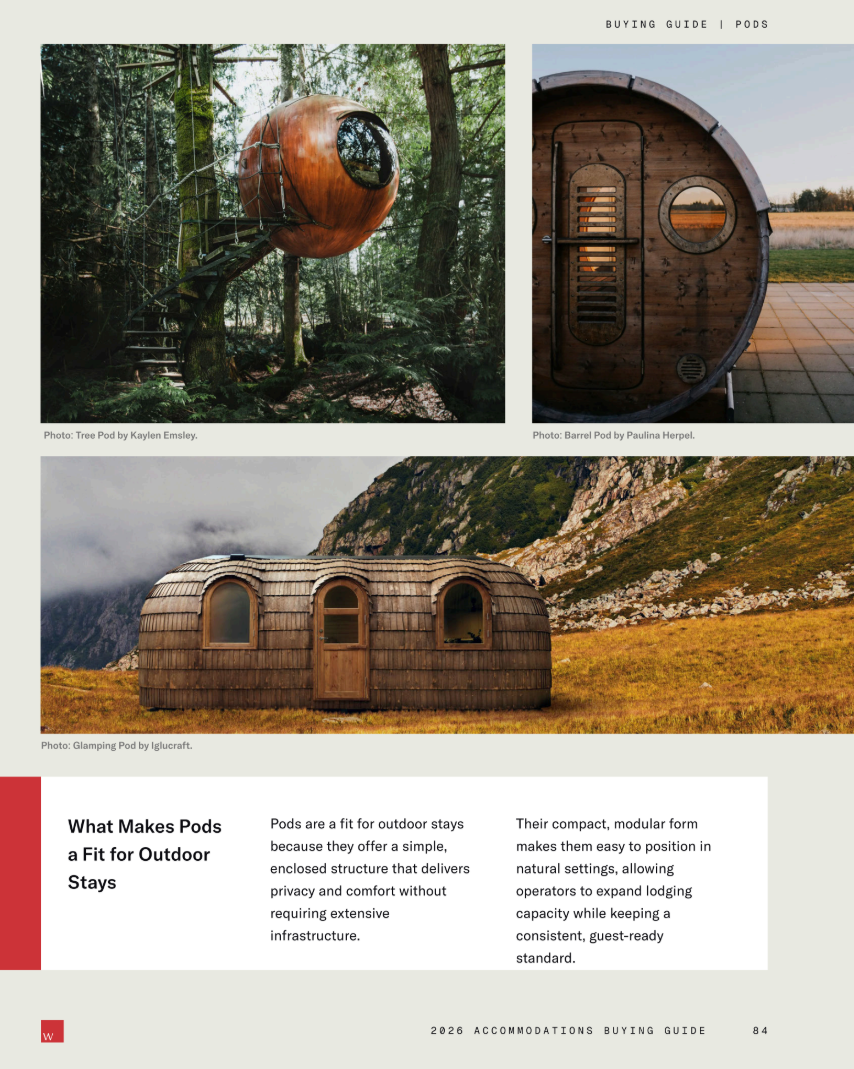
Pods may be the most practical category within the unique accommodations landscape.
Their appeal is rooted in efficiency. Compact footprints, modular construction, repeatable designs, and relatively straightforward installation make them attractive for operators seeking scalable inventory. Unlike some unique accommodations that depend heavily on a single signature experience, pods often excel because they can be replicated consistently across a property.
They also tend to fit well on sites where operators are balancing guest experience with operational realities. Many offer modern aesthetics, year-round usability, and lower site impact while still creating a lodging experience that feels different from a traditional hotel room or cabin.
For operators focused on adding inventory rather than creating a single iconic structure, pods can be a compelling solution.
Pause Before You Buy
Smaller doesn't always mean simpler.
One of the biggest challenges with pods is making compact spaces feel functional. Storage, luggage space, housekeeping access, furniture placement, accessibility, and guest comfort become increasingly important as square footage decreases.
The most successful pod developments are often obsessed with details. Every inch has a purpose. Every piece of furniture serves a function.
Before buying, ask yourself whether the design prioritizes guest comfort or simply minimizes manufacturing costs.
Wagons: Selling Heritage
At a Glance
Average Footprint: 150 to 350 sq. ft.
Typical Capacity: 2 to 6 guests
Price Range: $8,000 to $60,000+
Common Subcategories: Covered Wagons, Vardo Wagons, Luxury Wagons
Why Operators Buy Them
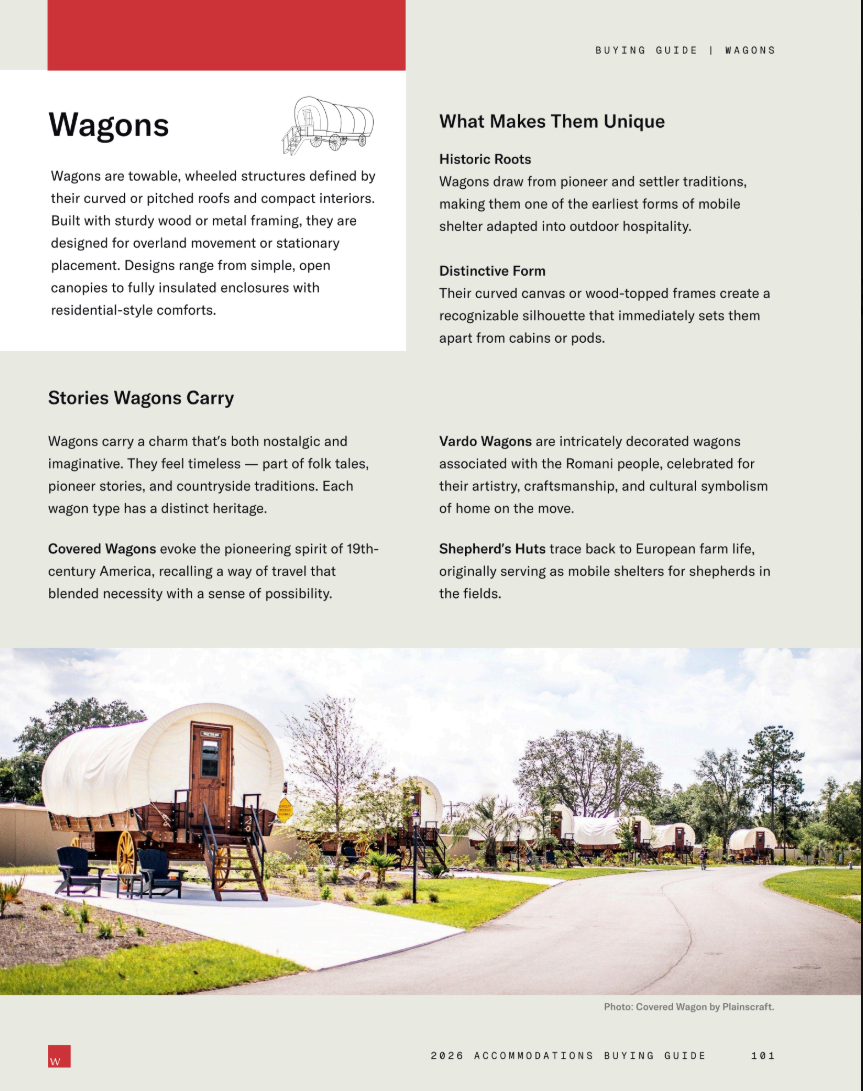
Wagons succeed because they immediately communicate a story.
Few accommodation types evoke a stronger sense of heritage, movement, and place. Whether inspired by pioneer routes, western ranching culture, or historic travel traditions, wagons create instant emotional connections for guests.
For operators, they can be particularly effective in destinations where local history and landscape reinforce the experience. Ranches, western resorts, desert destinations, and heritage properties often find that wagons feel like a natural extension of their brand.
Guests know exactly what they're looking at before they ever step inside.
That clarity can be incredibly powerful.
Pause Before You Buy
Wagons are strongest when they support a property's story. A wagon feels natural on a ranch, western resort, or heritage-driven destination, but can feel out of place in a modern luxury retreat or coastal resort. Before investing, make sure the accommodation reinforces the experience you're trying to create rather than competing with it.
Accessibility deserves careful consideration.Many wagon designs require guests to climb steps into an elevated sleeping space, which can create challenges for guests with mobility limitations, older travelers, or families traveling with young children. Fortunately, manufacturers have begun addressing this challenge. Companies like PlainsCraft (Also and AGA member!) have developed accessible wagon model.
Yurts: Selling Authenticity
At a Glance
Average Footprint: 200 to 1,000 sq. ft.
Typical Capacity: 2 to 8 guests
Price Range: $5,000 to $80,000+
Common Subcategories: Soft-Sided Yurts, Hard-Sided Yurts, Hybrid Yurts
Why Operators Buy Them
Yurts may be one of the oldest accommodation concepts represented in modern outdoor hospitality.Originally developed by nomadic cultures across Central Asia, yurts have endured for thousands of years because of their adaptability, efficiency, and practicality. Today, they occupy a fascinating middle ground between camping and cabin lodging.
Their circular layouts create an experience unlike traditional rectangular structures. Central skylights bring natural light into the space, while open interiors create a sense of spaciousness that often exceeds what guests expect based on the footprint.
Modern yurts have evolved significantly, with many manufacturers now offering insulated walls, upgraded flooring systems, kitchens, bathrooms, and year-round living capabilities.
For many operators, yurts represent one of the most approachable entry points into unique accommodations.
Pause Before You Buy
Yurts can be incredibly versatile, but moisture is often the real challenge. Condensation, humidity, ventilation, and mold prevention become critical considerations, particularly in cold climates, humid regions, or locations with large temperature swings. Many operators focus on insulation and snow loads but underestimate how much moisture can build up inside a structure when warm interior air meets cooler surfaces. Without proper ventilation and moisture management, condensation can reduce insulation performance, damage materials, and create long-term maintenance issues.
It's also important to recognize that not all yurts are built the same. Soft-sided yurts, hard-sided yurts, and hybrid models can perform dramatically differently in wind, snow, humidity, and extreme temperatures. Before purchasing, ask less about how the yurt looks and more about how it performs after a week of rain, a month of snow, or a season of high humidity. Those answers will tell you far more about its long-term viability than any brochure ever will.
A Unique Ending
What makes unique accommodations so compelling is also what makes them challenging. This category gives operators more ways than ever to create differentiation, activate land, tell stories, and build experiences guests can't easily find elsewhere. Whether that's a dome under dark skies, a wagon on a ranch, a treehouse tucked into a forest canopy, or a thoughtfully restored Airstream, the opportunity lies in using the niche to your advantage.
But opportunity doesn't eliminate the need for diligence.
Before making any investment, talk to operators who already own the product. Ask manufacturers for references and actually call them. Better yet, book a stay and spend a night in an operating unit. Walk through it as both a guest and an owner. Pay attention to the details guests don't see, from utility runs and climate control to maintenance access and wear over time.
And if you're serious about evaluating the category, equip yourself with the right information. One of the reasons we built Walden's Unique Accommodations Guide was to bring structure to a fragmented market. With more than 750 products across 137 manufacturers, side-by-side benchmarks, operator feedback, and consumer perspectives, it helps operators ask better questions before they make expensive decisions.
Because the most successful accommodation investments aren't usually made by the people who find the coolest product. They're made by the people who do the most homework.Tune in for Part II Cabins, and as always, keep your head heels and standards high
Walden’s Unique Accommodation Guides:

Through her work with Walden, Whitney Scott continues to help define the future of outdoor hospitality by providing the research, insights, and strategic guidance that operators and industry leaders rely on to make informed decisions. With an MBA from the University of Montana and executive training from the Kellogg School of Business, Whitney combines analytical expertise with real-world industry experience. Her commitment to advancing the glamping and outdoor hospitality industries has made her a trusted advisor, respected thought leader, and valued contributor to the American Glamping Association community and beyond.