Sojourn Lodging | From Land to Launch: What We Wish We Knew Before Opening Our Glamping Property
AGA Guest Blog contributed by Sojourn Lodging
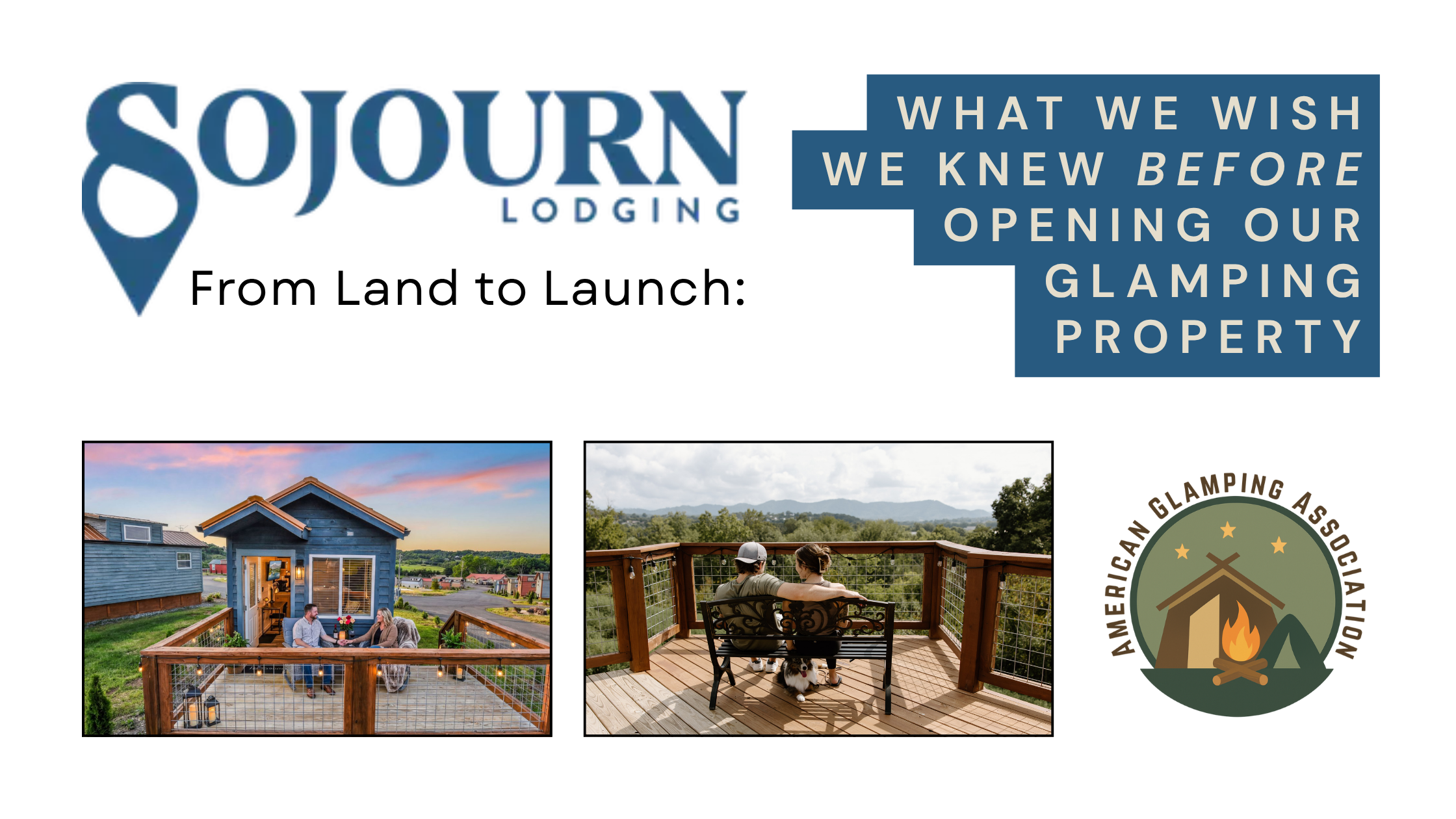
When we first envisioned Sojourn Lodging, the concept seemed relatively straightforward: create a community of thoughtfully designed tiny homes where guests could experience the character of the Smoky Mountains without giving up the comforts and connectivity of modern travel.
The tiny homes supported that vision. They could be built quickly, were relatively affordable compared with traditional lodging construction, and did not require permanent foundations because each unit was constructed on a mobile trailer.
On paper, this gave us a flexible and efficient path to development.
What we learned, however, is that developing a glamping or microlodging property involves much more than constructing the accommodations. The units may be the most visible part of the guest experience, but the land beneath them—and the infrastructure connecting everything—ultimately determines the development timeline.
Our first Sojourn property opened approximately two years later than we originally expected. The experience taught us valuable lessons about site selection, infrastructure, scheduling, permitting, and the importance of preparing for challenges that cannot be seen from the surface.
Bootstrapping the Sojourn Vision
Sojourn began with a vision from our founder, Anjan Ghosal, to develop a community of approximately 40 tiny homes.
Before moving forward, we created financial projections based on expected occupancy, average daily rates, operating expenses, and the property’s potential performance. Those assumptions helped us evaluate the business model and gave us the confidence to proceed.
Rather than relying on outside development capital, we chose to bootstrap the project. We reinvested revenue from our established cabin management business into the development of the first Sojourn property. We also handled much of the planning and development work in-house.
That approach gave us greater control and helped make the project possible, but it also meant that every delay directly affected our capital, timeline, and ability to begin generating revenue.
Bootstrapping made careful scheduling especially important—even though, at the time, we did not fully understand which parts of the project were most likely to become bottlenecks.
Building More Than a Place to Sleep
Our goal was never simply to place a collection of tiny homes on a parcel of land.
We wanted to create a destination where guests could enjoy a short stay without feeling that they had to completely disconnect from their everyday lives. Guests could have the privacy of their own accommodations while still experiencing the energy and atmosphere of a shared community.
Just as importantly, we wanted the property to feel connected to its destination. A stay at Sojourn should leave guests with memories of the place they visited—not merely the room where they slept.
For our Smoky Mountains location, that meant taking inspiration from the cabin accommodations that define Gatlinburg, Sevierville, and the surrounding region. The tiny homes offered a smaller and more modern format, but their character still needed to feel appropriate to the mountains.
That destination-driven approach remains central to the Sojourn concept. Microlodging has the opportunity to provide something a standardized hotel often cannot: accommodations shaped by the local culture, landscape, and reasons people travel to an area in the first place.
The Biggest Surprise Was Beneath the Surface
Our initial development assumptions focused heavily on how easy the tiny homes would be to build. What we underestimated was the amount of work required to prepare the property before a single unit could begin welcoming guests.
Every tiny home needed access to essential infrastructure, including water, electricity, wastewater connections, and reliable internet. Installing those systems took considerably longer than expected because of the property’s terrain and geology.
During excavation, we encountered extensive limestone rock that was extremely difficult and time-consuming to dig through or break down.
We later learned that the property sits above a cave system approximately four stories tall, with tunnels running beneath the site. It was an extraordinary natural feature—but also a major complication for infrastructure development.
By that point, many of the tiny homes had already been constructed. The units were ready, but the property was not. They had to wait off-site while the utility and site work caught up.
This created a frustrating development mismatch: the most visible part of the project appeared nearly complete, yet the infrastructure required to make the property operational remained unfinished.
Ultimately, the combination of difficult site work and other development roadblocks pushed our opening back by roughly two years.
A Tiny Home Does Not Mean a Tiny Development Project
One of our biggest lessons is that modular, mobile, or prefabricated accommodations do not automatically make the entire development process quick.
The units may be faster to produce than a traditional hotel building, but they still depend on many of the same underlying systems. Roads, grading, drainage, utilities, internet, fire access, permitting, inspections, parking, and common spaces all require careful planning and coordination.
For prospective glamping developers, it is easy to focus on the cost and construction schedule of the accommodations themselves. Those figures are important, but they tell only part of the story.
Site infrastructure can become the true critical path—especially when developing rural, mountainous, rocky, or otherwise unusual land.
If we were beginning again, we would place much greater emphasis on early geotechnical and site investigations. Understanding what is beneath the ground can be just as important as understanding what is permitted above it.
What We Would Do Differently
The experience gave us a clearer framework for approaching future Sojourn developments.
First, we would build significantly more time into the schedule for site preparation and utility installation. Even when the accommodations are quick to construct, the overall project timeline should be based on the most complex infrastructure component—not the fastest component.
Second, we would identify which parts of the project could move forward simultaneously. Infrastructure work, unit production, permitting, inspections, procurement, and operational planning do not always need to happen one after another.
With a clearer understanding of the dependencies, multiple workstreams can advance at the same time without creating completed units that have nowhere to go.
Third, we would establish the permitting and inspection sequence earlier. A project can lose considerable time when one inspection, approval, or utility connection must be completed before the next stage can begin.
Mapping those dependencies in advance makes it easier to identify potential blockers and keep the project moving.
Finally, we would approach the development with a more formal structure for timelines, contingencies, responsibilities, and decision points.
Our first project taught us where delays are most likely to occur. That knowledge will allow us to plan future developments with more realistic schedules and better-defined buffers.
Listening to What Guests Actually Want
The development process was only the beginning of our education. Once the property began operating, guest behavior helped us understand which features should play a larger role in future Sojourn locations.
Pet-friendly travel is one example. For many guests, bringing a dog is not a minor preference—it is a deciding factor when choosing accommodations.
Future properties should consider pet-friendly design from the beginning, including durable materials, practical outdoor areas, and clear operating policies.
We also saw the importance of facilities for groups and events. Individual tiny homes provide privacy, but group travelers still need places to gather.
Shared indoor and outdoor spaces can expand a property’s appeal for weddings, retreats, reunions, corporate groups, and other events while creating the sense of community that is central to the Sojourn experience.
These amenities should not be treated as afterthoughts. Their placement affects traffic flow, parking, utilities, noise management, accessibility, and the overall guest experience.
Designing them into the original site plan is far more effective than trying to add them later.
The Next Sojourn Will Belong to Its Destination
Although future Sojourn properties will build on the lessons from our Smoky Mountains location, they should not simply duplicate it.
Before developing in a new market, we would conduct detailed research into the area’s architecture, culture, landscape, travel patterns, and guest expectations. Those findings would help guide the accommodations, materials, shared spaces, and experiences offered at the property.
A coastal Sojourn should not feel like a mountain Sojourn, and a property near a national park should not feel interchangeable with one outside a historic town.
Each location should have its own identity while maintaining the comfort, community, and efficient use of space that define the broader Sojourn brand.
The goal is to give guests an experience that cannot be replicated by a conventional hotel—or by another Sojourn in a different destination.
Our Most Important Lesson
If there is one lesson we would share with other glamping and microlodging developers, it is this:
Do not confuse accommodations that are easy to build with a property that is easy to develop.
Spend time understanding the land. Investigate the geology, map the utilities, study the permitting sequence, and identify the project’s true critical path before ordering or constructing every unit.
Build contingency into both the schedule and the budget, particularly when developing rural or mountainous sites.
Our first Sojourn took longer to open than we imagined, but the challenges gave us a much stronger foundation for the future. We now understand where the hidden risks are, how the different stages of development depend on one another, and which amenities matter most to the guests we serve.
The next time we move from land to launch, we will do so with a more realistic timeline, a more structured development plan, and an even clearer vision for creating accommodations that truly belong to their destination.