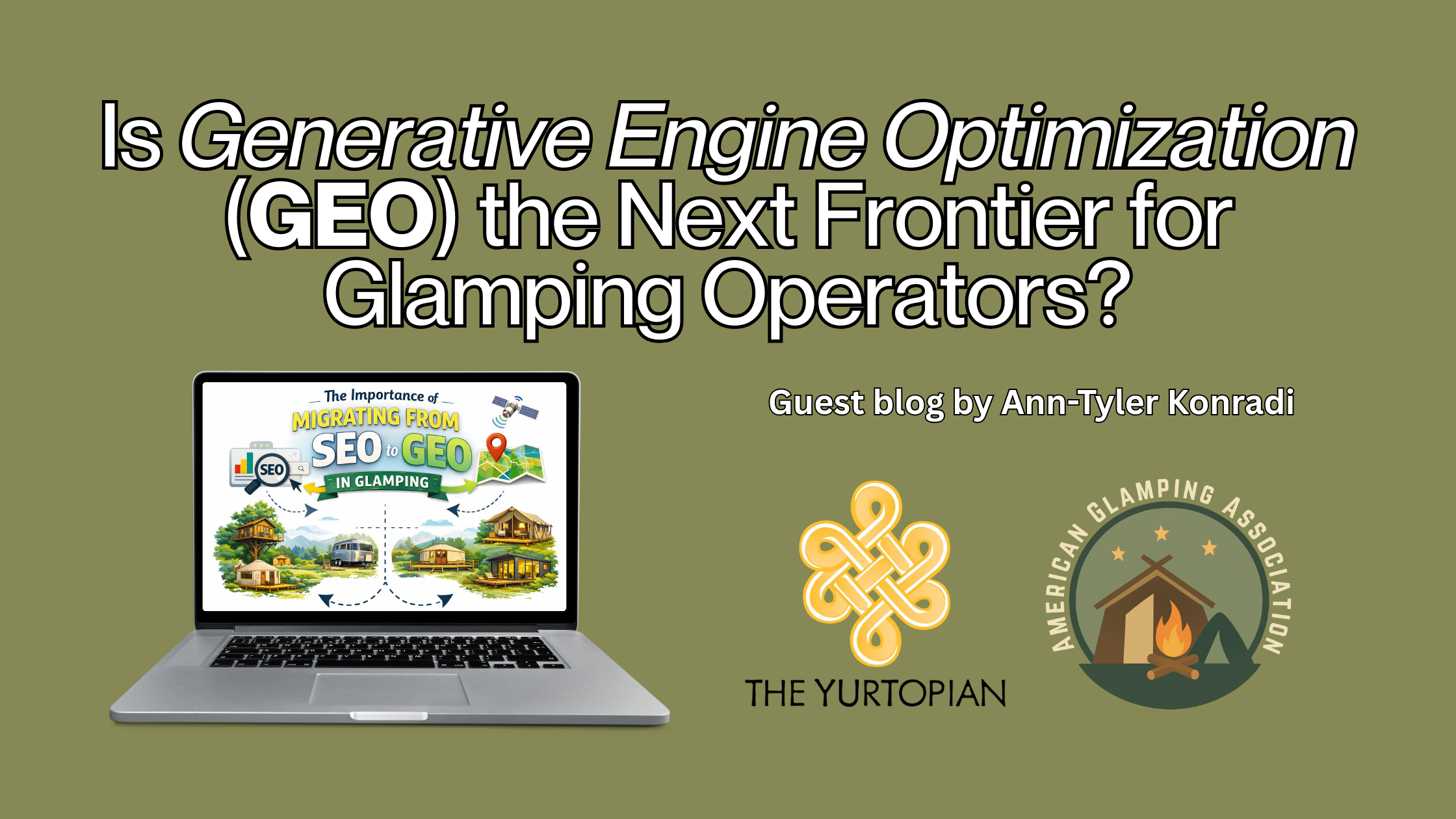
The Importance of Migrating from SEO to GEO
Why Generative Engine Optimization Is the Next Frontier for Glamping Operators
Guest blog by Ann-Tyler Konradi, co-founder of The Yurtopian, a luxury glamping resort in the Texas Hill Country.
By now, most glamping operators understand the fundamentals of Search Engine Optimization (SEO).
You’ve optimized your website with targeted keywords.
You may have implemented structured data (schema markup).
You might be running Google Ads so your brand appears when travelers search phrases like:
● “Glamping in yurts in Texas”
● “Romantic cabin in the woods”
● “Best glamping near Austin”
But have you heard of Generative Engine Optimization (GEO)?
Because whether we’re ready or not, traveler behavior is shifting.
From Search Engines to Generative Engines
Traditional SEO focuses on ranking in search engines like Google. GEO focuses on being cited, referenced, or recommended inside AI-powered conversational tools such as:
● ChatGPT
● Google Gemini
Instead of typing a short keyword query, travelers are now asking layered, conversational prompts like:
“Plan a 3-day romantic anniversary trip in the Texas Hill Country with wineries, scenic views, and a unique place to stay.”
According to a study by TakeUp.ai, which surveyed 300 travelers about AI usage in trip planning:
● 38% had used AI tools for travel planning.
● Of those users, 63% said they used AI for most or all of their planning.
● 96% said they intend to continue using AI for future trips.
In other words, adoption may feel gradual — but once travelers switch to conversational AI, they tend not to revert to traditional search alone.
As Adriana Lee noted in Skift:
“It’s a critical split in the modern travel funnel: Travelers are using conversational AI to navigate the messy middle of trip planning, asking for multi-layered itineraries that are two to three times longer than a standard keyword query.”
This “messy middle” is exactly where glamping thrives — experiential, romantic, unique stays that require storytelling, not just keywords.
The Big Question: How Do You Get Listed in AI Results?
Unlike SEO, there is no simple dashboard where you can “rank #1” in ChatGPT.
GEO is a longer game — and it’s still evolving — but here’s what I’m doing so far at The Yurtopian.
Step 1: Track Your Visibility in LLM Responses
You can’t optimize what you don’t measure.
There are emerging tools that monitor how often your property appears in AI-generated travel responses:
● Semrush (comprehensive but expensive)
● Peec.ai (more cost-effective and GEO-focused)
Using tools like these, you can:
● Set up specific prompts (e.g., “most romantic getaway in Texas”)
● Track whether your resort is mentioned
● Identify which sources the AI model is citing
The source data is where it gets interesting.
Step 2: Follow the Sources (They May Surprise You)
We tend to assume AI pulls primarily from official brand websites.
In reality, many LLMs appear to heavily reference:
● Reddit threads
● Substack articles
● Independent blogs
● Opinion-based travel content
Older blog posts — even from three years ago — often surface prominently. I’ve found articles listing five glamping spots in our area, two of which were permanently closed.
That creates opportunity.
If you discover outdated content ranking as a source, reach out to the blogger. Offer updated information. Invite them to visit. Help them refresh the article. When they update, AI models may refresh their knowledge base accordingly.
In GEO, digital PR is back in style.
Step 3: Create AI-Friendly Content on Your Own Website
GEO does not replace SEO — it builds on it.
LLMs tend to favor content that is:
● Structured with clear headlines
● Organized with bullet points
● Written in natural language
● Framed around questions and answers
● Experience-driven
For glamping operators, this means publishing content like:
● “3-Day Romantic Texas Hill Country Itinerary”
● “Yurt vs Dome vs Treehouse: Which Glamping Stay Is Right for You?”
● “Best Wineries Near [Your Property]”
● “What to Pack for a Luxury Glamping Trip”
This type of blog content accomplishes two goals:
1. It improves traditional SEO.
2. It increases the likelihood that AI tools pull your content into conversational responses.
Backlinks still matter. Authority still matters. Freshness still matters.
But formatting and context matter more than ever.
The Strategic Shift: From Keywords to Conversations
Traditional SEO is built around short keyword phrases.
GEO is built around:
● Intent
● Context
● Multi-layered questions
● Narrative recommendations
Travelers aren’t just searching for “glamping Texas” anymore.
They’re asking:
“Where can I celebrate a 40th birthday with girlfriends, drink wine, and stay somewhere unique within driving distance of Houston?”
If your content doesn’t speak to that level of specificity, AI won’t surface you.
Final Thoughts: Is It Too Early to Worry About GEO?
No.
Even if only 38% of travelers are currently using AI tools, the behavioral stickiness is strong. Once they shift to conversational planning, they stay there.
For glamping operators, this presents both a challenge and an opportunity:
● The challenge: You can’t simply buy your way into AI visibility (yet).
● The opportunity: Authentic, well-structured, experience-rich content may outperform large competitors who rely solely on paid ads.
I’m still learning. The landscape is evolving rapidly.
But one thing feels clear:
SEO got us found in search. GEO will determine whether we’re recommended in conversation.
And in experiential hospitality, conversation is where decisions are made.

Ann-Tyler Konradi is the co-founder of The Yurtopian, a luxury glamping resort in the Texas Hill Country. Since opening in 2019, The Yurtopian has grown from one handcrafted Mongolian yurt to a nationally recognized brand through a combination of influencer partnerships, SEO & GEO strategy, and paid media campaigns.